



The Silvered-Leaf Monkey (Trachypithecus cristatus) is one of the most recognizable primates found in the mangrove and coastal forests of western Peninsular Malaysia. One of the best-known populations lives around Kuala Selangor, where these monkeys have adapted to coexist relatively closely with human activity, particularly in ecotourism zones such as mangrove reserves and riverine parks. Their calm behavior, striking appearance, and social structure make them a frequent subject of interest to visitors exploring the region’s natural environment.
These monkeys belong to the colobine group, a subfamily of Old World monkeys that are primarily leaf-eaters and possess specialized digestive systems. In Kuala Selangor, they are often seen resting in mangrove trees, moving in small troops, or feeding on young leaves, shoots, and fruits. Unlike more aggressive macaques, silvered-leaf monkeys tend to be relatively quiet and less confrontational, although they remain wild animals and should not be approached or fed directly.
Appearance and General Characteristics
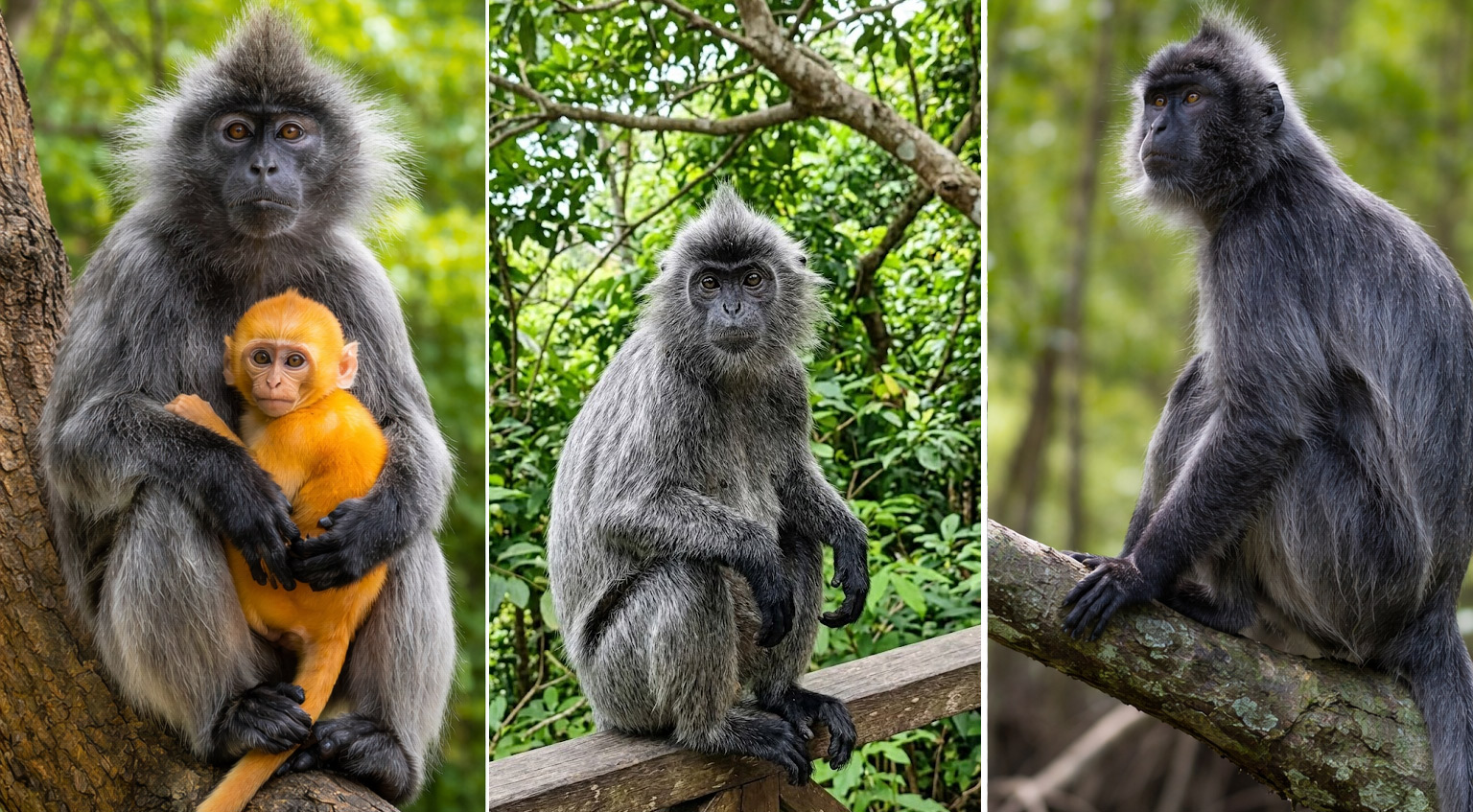
Adult silvered-leaf monkeys are named for their distinctive grey to silvery fur, which often appears darker on the back and lighter on the underside. Their heart-shaped face is generally dark, framed by lighter fur, giving them a masked appearance. Their long tails are not prehensile but are used for balance when moving through the canopy.
Males and females are similar in size, with adults typically weighing between 5 and 8 kilograms. Their bodies are slender and adapted for arboreal life, allowing them to move efficiently through trees in mangrove ecosystems. They are highly social animals, living in groups that may range from a few individuals to more than twenty, often structured around a dominant male with multiple females and juveniles.
In Kuala Selangor, they are especially visible near the riverbanks and mangrove edges where food resources are abundant and where human disturbance is relatively predictable. Their ability to exploit mangrove vegetation has allowed them to remain stable in certain areas despite habitat changes.
Why Baby Silvered-Leaf Monkeys Are Orange
One of the most striking features of this species is the bright orange or golden coloration of newborn infants. While adults are grey or silver, infants are born with a vivid orange coat that gradually changes to adult coloration over several months.
The exact reason for this coloration is not fully tied to a single mechanism, but it is widely understood to serve several important biological and social functions:
-
Social attention and care
The orange color makes infants highly visible within the troop. In social primate groups, infant survival depends heavily on attention from not only the mother but also other group members. This phenomenon is known as “alloparenting,” where individuals other than the mother may help protect or carry the infant. The bright coloration acts as a visual signal that draws attention and encourages protective behavior. -
Reduced aggression from adults
In many primate species, juveniles may face aggression or competition within the group. The distinctive coloration of infants helps distinguish them clearly as non-threatening, immature individuals. This reduces the risk of accidental aggression from other group members. -
Enhanced protection against predators
Although it may seem counterintuitive, high visibility can sometimes improve survival in social species. The infant is easier for the group to monitor, and adults are more likely to respond quickly to threats when the infant stands out visually.
As the infant matures, the orange fur gradually fades (usually after 5 months) and transitions into the characteristic grey-silver coloration of adulthood. This change typically occurs within several months as the monkey becomes more independent and less reliant on constant group protection.
Lifespan and Growth
Silvered-leaf monkeys have different life expectancies depending on whether they live in the wild or in captivity.
In natural environments such as Kuala Selangor’s mangrove forests, their average lifespan is typically around 15 to 20 years. Survival in the wild depends on factors such as food availability, habitat stability, predation (especially for young individuals), and human disturbance.
In captivity, where food is consistent and medical care is available, they can live longer, often reaching 25 to 30 years. However, wild populations tend to have more natural behavioral expression and social dynamics.
Infants grow relatively quickly in the first year of life. After the initial orange phase, juveniles begin developing adult coloration and gradually integrate more independent feeding behaviors. Sexual maturity is usually reached between 3 and 5 years of age, depending on environmental conditions and social hierarchy.
Diet and Feeding Behavior
The silvered-leaf monkey is primarily folivorous, meaning its diet consists largely of leaves. However, they are not strict leaf specialists and will also consume fruits, flowers, seeds, and young shoots when available. In mangrove ecosystems like Kuala Selangor, they often feed on mangrove leaves, which are rich in fibrous material but low in easily digestible nutrients.
Leaves are not easy to digest, which is why these monkeys have evolved a highly specialized digestive system. They selectively feed on young leaves, which contain fewer toxins and are easier to break down. Feeding behavior is usually slow and deliberate, with long periods of resting in between to allow digestion.
Unlike many other primates that rely heavily on fruit, silvered-leaf monkeys are well adapted to environments where fruit is seasonal or limited. This dietary flexibility is one reason they can thrive in mangrove ecosystems.
Stomach Structure and Digestive Adaptation
One of the most important biological features of silvered-leaf monkeys is their specialized stomach structure. As members of the colobine subfamily, they possess a complex, multi-chambered stomach that functions in principle similarly to the digestive systems of ruminants such as cows.
This system is known as foregut fermentation. Instead of relying solely on the intestines to break down plant material, these monkeys use stomach bacteria to ferment leaves before digestion continues.
Their stomach is divided into multiple compartments, each serving a different function:
-
Fermentation chamber
The largest compartment houses symbiotic bacteria that break down cellulose, the tough structural component of leaves. This fermentation process allows the monkey to extract nutrients that would otherwise be inaccessible. -
Sorting and absorption areas
After fermentation, partially digested food moves through additional chambers where nutrients are absorbed more efficiently. This staged process increases the overall energy yield from a low-quality food source. -
Detoxification role
Many leaves contain chemical compounds that are toxic or difficult to digest. The bacterial community in the stomach helps neutralize or break down some of these compounds before they reach the intestines.
This digestive system allows silvered-leaf monkeys to survive in habitats where high-energy foods are not always available. In Kuala Selangor’s mangrove environment, where leaves are abundant but fruits are less consistent, this adaptation is particularly important for survival.
Because fermentation takes time, these monkeys spend a large portion of the day resting and digesting rather than constantly foraging. This behavior is commonly observed in Kuala Selangor, where groups are often seen sitting quietly in trees during the midday hours.
Social Structure and Behavior
Silvered-leaf monkeys live in structured social groups. A typical group consists of one dominant male, several females, and their offspring. The dominant male is responsible for protecting the group from external threats and competing males, while females are primarily responsible for nurturing and raising young.
Within the group, social bonds are important. Grooming behavior helps maintain relationships and reduce tension. Infants are frequently handled by multiple females, not just their mothers, reinforcing group cohesion.
In Kuala Selangor, where human presence is common due to tourism activities, these monkeys have shown a degree of behavioral adaptation. While they remain wild, some groups have become accustomed to boats passing along rivers or visitors observing them from a distance. However, direct feeding by humans can disrupt natural foraging patterns and should be avoided.
Habitat in Kuala Selangor
Kuala Selangor provides a suitable habitat due to its combination of mangrove forests, river systems, and protected areas. The mangrove ecosystem offers both food and shelter, while tall trees provide safe resting and sleeping sites away from ground-based threats.
These monkeys are arboreal but may occasionally descend to the ground to move between trees or access certain food sources. Their presence in Kuala Selangor also indicates a relatively healthy mangrove ecosystem, as they depend on a stable supply of vegetation and intact forest structure.
Their distribution is closely linked to areas with minimal disturbance and sufficient canopy connectivity, which allows them to travel efficiently without exposure to predators or human hazards.
Visitors can observe silvered-leaf monkeys at Melawati Hill (Bukit Melawati) in Kuala Selangor, where troops are commonly seen around the forested areas and historical surroundings near the hilltop. These monkeys are accustomed to human presence here, so sightings are relatively frequent, especially during daytime when they rest or move between trees.
Contact Lawrence Blue, a licensed Malaysian tour guide, to bring you to places of interest in Kuala Lumpur.



