



The Petronas Twin Towers are the most recognizable landmark in Kuala Lumpur and a defining symbol of Malaysia’s rapid economic development in the late 20th century. Completed in 1998, the towers held the title of the world’s tallest buildings until 2004 and remain the tallest twin towers ever constructed. Rising to a height of 452 metres with 88 storeys above ground, they dominate the skyline of Kuala Lumpur and serve as both a commercial hub and a major tourist attraction.
Designed by Argentine-American architect César Pelli, the towers incorporate Islamic geometric patterns into their floor plan. The design is based on an eight-pointed star, symbolizing unity, harmony, stability, and rationality—values associated with Islamic architecture. This blending of cultural symbolism with advanced engineering gives the towers a distinct identity that reflects Malaysia’s heritage alongside its modern ambitions.
Construction Overview and International Collaboration
One of the most notable aspects of the Petronas Twin Towers is the international collaboration involved in their construction. To accelerate the building process and ensure competition-driven efficiency, the project was divided between two major consortia from different countries.
-
Tower 1 was constructed by a Japanese-led consortium headed by Hazama Corporation. This group included companies from Japan and several other partners.
-
Tower 2 was built by a South Korean-led consortium headed by Samsung C&T, working alongside other international firms.
The SkyBridge, which connects the two towers at levels 41 and 42, was constructed by a separate team led by Kukdong Engineering & Construction (now part of a larger Korean construction group).
This division of work between different countries not only reflected Malaysia’s openness to global expertise but also introduced a unique competitive element into the project.
Construction Timeline and Competition
Construction of the towers began in 1993 after extensive site preparation, which included relocating the original plan due to unsuitable ground conditions. The foundation work was one of the most complex aspects, involving some of the deepest concrete foundations ever poured at the time.
Both Tower 1 and Tower 2 were built simultaneously, but by different contractors working independently. This created a direct competition between the two teams to complete their respective structures first.
Although both consortia began construction around the same period, progress differed slightly due to engineering challenges and execution efficiency.
-
The Japanese consortium working on Tower 1 started construction slightly earlier.
-
However, the South Korean consortium led by Samsung C&T completed Tower 2 first, finishing ahead of Tower 1 by a short margin.
This outcome is often cited as an example of how competitive project structuring can improve efficiency in large-scale engineering works. Despite the competition, both towers were completed within a similar timeframe, allowing the overall project to proceed smoothly.
Structural Design and Engineering Features
The Petronas Twin Towers were constructed primarily using high-strength reinforced concrete rather than steel, which is more commonly used in skyscrapers. Both cost considerations and material availability influenced this choice in Malaysia at the time. Concrete also provided greater rigidity, which is important for tall buildings in regions subject to wind loads.
Each tower has 88 floors above ground and five basement levels. The façade consists of stainless steel and glass, creating a reflective surface that changes appearance depending on lighting conditions.
A key engineering feature is the SkyBridge, located 170 metres above ground. Unlike typical fixed bridges, this structure is designed to slide in and out of the towers to accommodate building movement caused by wind and thermal expansion. It also serves as an emergency evacuation route between the towers.
The SkyBridge: Design and Function
The SkyBridge is one of the most distinctive elements of the Petronas Twin Towers. Spanning approximately 58 metres, it connects the two towers at the 41st and 42nd floors.
Built by the South Korean contractor Kukdong Engineering & Construction, the bridge was prefabricated and then lifted into position using specialized equipment. The installation process required precise coordination due to the structure’s height and weight.
Functionally, the SkyBridge serves several purposes:
-
It provides structural stability by linking the towers.
-
It acts as an emergency evacuation route.
-
It serves as a viewing platform for visitors.
Today, it is one of the most popular sections of the towers for tourists, offering panoramic views of Kuala Lumpur.
Occupants of the Towers
The Petronas Twin Towers primarily function as office buildings, housing a mix of multinational corporations, financial institutions, and government-linked companies.
Tower 1 Occupants
Tower 1 is largely occupied by Petroliam Nasional Berhad, commonly known as Petronas. As Malaysia’s national oil and gas company, Petronas uses the tower as its headquarters. Various departments and subsidiaries operate within this building, making it the corporation’s administrative center.
In addition to Petronas, several other companies and organizations lease office space within Tower 1, contributing to its role as a major business hub.
Tower 2 Occupants
Tower 2 houses a range of international corporations, including companies from sectors such as finance, consulting, and technology. Notable tenants have included global firms such as:
-
- Microsoft – Regional offices and corporate operations
- IBM – Consulting and technology services
- Bloomberg – Financial data and media services
- Accenture – Management consulting and digital services
- McKinsey & Company – Strategy and business consulting
- Boeing – Regional support and liaison office
- Al Jazeera – Regional media operations
- Reuters – Financial and news services
- Huawei – Regional business and telecom-related operations
- Cisco Systems – Enterprise networking and solutions
- ExxonMobil – Corporate or liaison presence
- Shell – Selected corporate functions and regional coordination
Tourism and Visitor Experience
Beyond their function as office towers, the Petronas Twin Towers are a major tourist attraction. Visitors can access designated areas, including the SkyBridge and an observation deck on the upper floors.
At the base of the towers is Suria KLCC, a large shopping complex featuring international brands, restaurants, and entertainment facilities. Adjacent to the towers is KLCC Park, a landscaped green space with walking paths and a musical fountain.
The towers are particularly striking at night when illuminated, creating one of the most photographed skylines in Southeast Asia.
Location and Accessibility
The Petronas Twin Towers are located in the Kuala Lumpur City Centre (KLCC) district, one of the city’s main commercial and tourist areas.
They are easily accessible via:
-
LRT (Light Rail Transit): KLCC Station on the Kelana Jaya Line
-
Taxi or e-hailing services: Widely available throughout the city
-
Walking: Connected to nearby hotels and shopping areas via pedestrian walkways
Operating Hours and Ticket Information
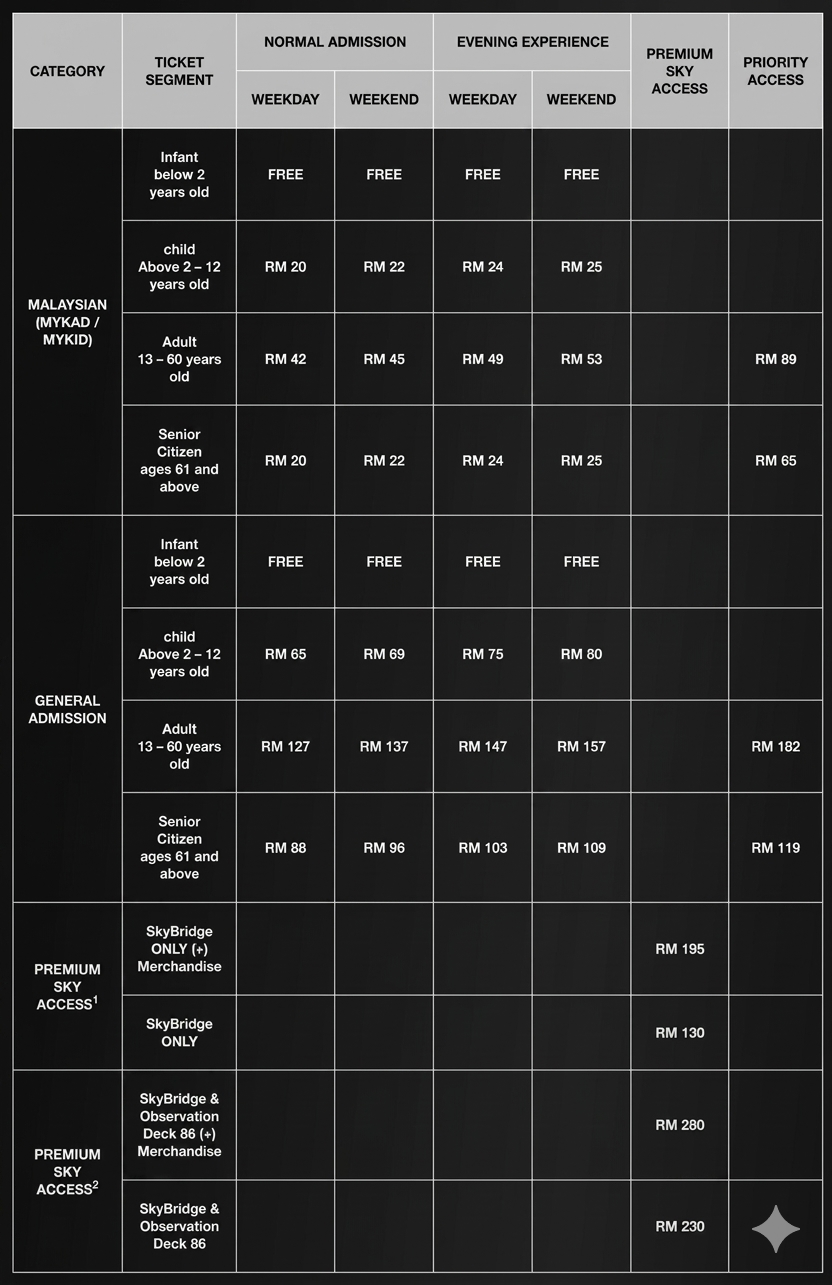
To access the SkyBridge on the 41st floor and the Observation Deck on the 86th floor, a ticket is required.
Tickets are sold in limited numbers per day, and booking is recommended, especially during peak tourist seasons.
Closed on Hari Raya Aidilfitri Celebration
Tuesday – Sunday / Public Holidays
9.00 am to 9.00 pm. Last admission is at 8.30 pm (open throughout Friday prayers)
Monday
Closed (except Public Holidays or Replacement Public Holidays on Monday):
Open on 2nd and 4th Monday of the month (9.00 am to 8.00 pm. Last admission 7.00 pm.)
Significance and Legacy
The Petronas Twin Towers represent more than just architectural achievement. They symbolize Malaysia’s transformation into a modern, industrialized nation. Their construction showcased the country’s ability to execute complex, large-scale infrastructure projects with international collaboration.
Even after losing the title of the world’s tallest building, the towers remain an enduring icon. Their unique twin structure, combined with cultural design elements and engineering innovation, continues to attract millions of visitors each year.
Contact Lawrence Blue, a licensed Malaysian tour guide, to bring you to places of interest in Kuala Lumpur.


