



The Kuala Gandah Elephant Conservation Centre, located within the Krau Wildlife Reserve in Pahang, Malaysia, is the country’s primary facility dedicated to the protection and management of the Asian elephant. Established in 1989 by the Department of Wildlife and National Parks (PERHILITAN), the centre serves as the operational base for Malaysia’s Elephant Relocation Team, which has been active since 1974.
The core function of the centre is not tourism, but conservation. Its main objectives include rescuing displaced elephants, mitigating human–elephant conflict, rehabilitating orphaned calves, and relocating elephants to safer habitats such as Taman Negara.
Location, Scale, and Operational Facts
The centre is situated near Temerloh, approximately 1.5 to 2 hours’ drive from Kuala Lumpur. It lies within the Krau Wildlife Reserve, one of the most important protected forest ecosystems in Peninsular Malaysia.
Several key figures highlight its operational scope:
-
Established: 1989
-
Elephant relocation programme started: 1974
-
Estimated wild elephants in Peninsular Malaysia: about 1,200 individuals
-
Resident elephants at the centre: around 20–30 individuals at any given time
The number of elephants fluctuates because animals are regularly transferred back into the wild after rehabilitation, while new individuals are brought in from conflict zones.
Daily Operations and Visitor Programme
The centre follows a structured daily programme designed primarily for education:
-
Morning: Observation of elephants within controlled forest enclosures
-
Early afternoon: Documentary screening on elephant translocation
-
Mid-afternoon: Elephant bathing sessions in the river
-
Late afternoon: Educational talks and demonstrations
Daily Activities in the Conservation Centre
TIME | PLACE | ACTIVITY
10:30 am
-
-
Place: Main Gate
-
Activity:
The main gate opens for visitors. Park your car in the parking area and register at the registration building.
-
10:30 am – 3:30 pm
-
-
Place:
-
Electric Fence (Elephants Observation Area)
-
Baby Elephant Area
-
-
Activity:
Feeding the elephants and photography.
-
1:00 pm & 1:30 pm
-
-
Place: Auditorium
-
Activity:
Video Show
Visitors can watch a documentary video in air-conditioned rooms. The documentary is about issues affecting wild elephants, the disappearing habitats, the role of the Elephant Transplantation Team in ensuring the survival of this endangered species, and the process of moving wild elephants from conflict areas to new habitats. The showing time is around 20 to 25 minutes.
Schedule for Video Show
Monday to Friday – 1.00 pm to 1.30 pm, 1.30 pm to 2.00 pm
Saturday /Sunday – 12.30 pm to 1 pm, 1.00 pm – 1.30 pm, 1.30 pm to 2.00 pm
-
11:15 am – 11:30 am (Weekends and Public Holidays only)
-
-
Place: Stage
-
Activity:
Informative Show (The bonding between elephants and mahout, depending on weather conditions)
-
2:15 pm
-
-
Place: Riverside (in the area of baby elephants)
-
Activity:
Adult elephants bathe with mahout (activity depends on river water level and weather) – 2nd session only at 2:15 pm
-
3:00 pm (Weekdays, weekends, and Public Holidays)
-
-
Place: Stage
-
Activity:
Informative Show (The bonding between elephants and mahout, depending on weather conditions)
-
2:45 pm – 3:15 pm (Friday only)
-
-
Place: Next to the area of baby elephants
-
Activity:
Make friends with the baby elephants (depending on the baby elephants’ health condition)
-
3:30 pm
-
-
Place: Main Gate
-
Activity:
The main gate is closed to visitors. Visitors already inside the centre may remain until 4:15 pm.
-
Note:
All activities depend on the river water level and current weather conditions. If the river level is high or there is heavy rain, activities may be cancelled.
Importantly, there are no elephant-riding activities at Kuala Gandah. This policy reflects Malaysia’s conservation-based approach rather than an entertainment-driven wildlife tourism approach.
Visitors may feed elephants with approved food, such as sugar cane, and occasionally assist with supervised bathing sessions. These activities are controlled and intended to promote understanding rather than exploitation.
The Asian Elephant: Biology and Conservation Status
The elephants found in Malaysia belong to the species Elephas maximus, commonly known as the Asian elephant. This species is classified as Endangered due to habitat loss, fragmentation, and human conflict.
Population and Habitat
In Peninsular Malaysia, the estimated population is approximately 1,200 individuals, distributed mainly across forest reserves such as Taman Negara and Endau-Rompin.
The primary threat is habitat encroachment. As forests are cleared for agriculture, plantations, and infrastructure, elephants are forced into human settlements, leading to crop destruction and property damage. The relocation work carried out by Kuala Gandah is therefore critical in reducing these conflicts.
Ecological Role
Asian elephants are considered “ecosystem engineers.” They:
-
Create forest pathways by knocking down vegetation.
-
Disperse seeds through dung.
-
Modify landscapes, benefiting smaller species.
These roles contribute significantly to biodiversity maintenance in tropical rainforests.
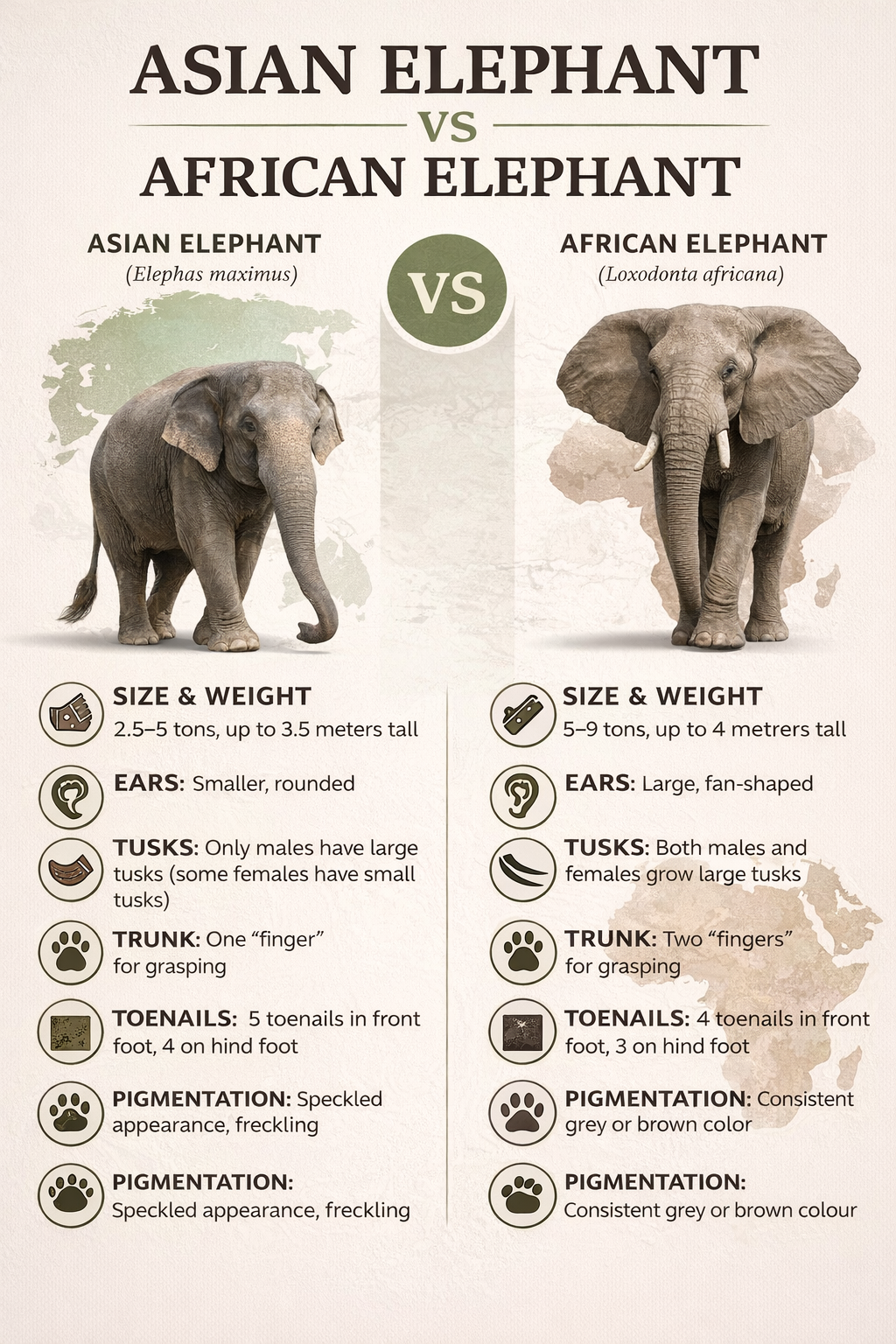
Asian vs African Elephants: Key Differences
Although both belong to the same family, Asian and African elephants differ significantly in morphology, behaviour, and domestication history.
Physical Differences
According to wildlife research:
-
Asian elephants have smaller, rounded ears.
-
African elephants have large, fan-shaped ears.
-
Only some male Asian elephants have tusks.
-
Both male and female African elephants typically have tusks
In addition, African elephants are generally larger.
Behavioural and Functional Differences
Asian elephants have a long history of interaction with humans, particularly in logging and transport. This has made them more manageable in controlled environments. African elephants, by contrast, are less commonly domesticated and are generally more difficult to train.
These differences explain why elephant-based tourism in Asia has historically been more widespread.
Malaysia’s Approach: No Elephant Riding
Unlike several other Asian countries, Malaysia does not promote elephant riding as a tourist activity. Kuala Gandah explicitly prohibits it and focuses on conservation, education, and rehabilitation.
This distinction is important. In many parts of Southeast Asia, elephants are used for:
-
Tourist rides
-
Circus performances
-
Entertainment shows
Such uses often require intensive training methods that raise serious ethical concerns.
The Reality of Elephant “Training” in Some Countries
In certain regions, particularly where elephant tourism is commercially driven, young elephants undergo a process designed to make them submissive to humans. This process is often referred to as “breaking” the elephant.
The Process
Although practices vary, the general method includes:
-
Separating calves from their mothers at a young age
-
Confining them in restricted enclosures or wooden frames
-
Repeated physical punishment over days or weeks
-
Enforcing obedience through fear and exhaustion
The objective is to suppress the animal’s instincts and establish human dominance.
Consequences
This process can result in:
-
Long-term psychological stress
-
Abnormal behaviour patterns
-
Reduced lifespan in captivity
-
Increased aggression or depression
Once “trained,” these elephants may be used for riding, performances, or tourist interactions.
Contrast with Kuala Gandah
Kuala Gandah adopts a fundamentally different approach:
-
Elephants are rescued, not captured for labour
-
Training is limited to necessary handling for relocation and medical care.
-
The long-term goal is reintegration into natural habitats whenever possible.
This aligns with modern wildlife conservation principles rather than commercial exploitation.
Elephant Relocation Programme
One of the centre’s most important functions is the Elephant Relocation Team.
Operational Method
When elephants enter plantations or villages, trained teams:
-
Track the animals
-
Safely capture them using experienced elephants.
-
Transport them to protected forest reserves.
This method reduces both human economic losses and elephant fatalities.
Scale of Impact
Since the programme began in 1974, hundreds of elephants have been relocated across Peninsular Malaysia.
This makes Kuala Gandah one of the most significant elephant management centres in Southeast Asia.
Resident Elephants and Rehabilitation
The centre houses a group of resident elephants that serve multiple purposes:
-
Assisting in relocation operations
-
Acting as “trainer” elephants for wild captures
-
Providing educational exposure for visitors
Some elephants are permanent residents due to injury, orphaning, or inability to survive in the wild.
Others are temporary residents undergoing rehabilitation before release.
Education and Public Awareness
Education is a major component of the centre’s mission. Visitors are exposed to:
-
Documentary footage on elephant relocation
-
Interpretive talks by wildlife officers
-
Direct observation of elephant behaviour
This structured approach ensures that tourism supports conservation rather than exploitation.
Address
Contact Lawrence Blue, a licensed Malaysian tour guide, to bring you to places of interest in Pahang.


